


Medicare Advantage vs. Original Medicare: Which Is Right for You?
If you're approaching 65 or getting ready to enroll in Medicare for the first time, you've probably discovered that Medicare isn't quite as straightforward as you expected.
There's Part A, Part B, Part C, and Part D. There's Original Medicare, Medicare Advantage, and something called Medigap. And everyone seems to have an opinion about which option is best.
Here's the good news: You don't have to become a Medicare expert to make an informed decision.
Understanding the differences between Medicare Advantage and Original Medicare is a great place to start. Both provide important healthcare coverage, but they work differently when it comes to costs, doctors, prescription medications, and how you access care.
Let's break down what you need to know so you can choose coverage that fits your healthcare needs, budget, and lifestyle.
What is Original Medicare?
Original Medicare is the traditional federal health insurance program administered by the government. It includes two parts:
-
Part A (Hospital Insurance): Helps cover inpatient hospital care, qualifying skilled nursing facility care, hospice care, and certain home healthcare services.
-
Part B (Medical Insurance): Helps cover doctor visits, outpatient care, preventive services, medical equipment, and other medically necessary services.
One of Original Medicare's biggest advantages is flexibility. You can generally visit any doctor or hospital in the United States that accepts Medicare, without worrying about a particular insurance company's provider network.
However, Original Medicare doesn't pay for everything. After meeting applicable deductibles, you'll often pay 20% of the Medicare-approved amount for Part B-covered services. There's also no annual limit on your out-of-pocket spending under Original Medicare alone.
You can add a separate Part D prescription drug plan and may be able to purchase Medicare Supplement Insurance, also called Medigap, to help cover certain out-of-pocket expenses.
What is Medicare Advantage?
Medicare Advantage, also called Medicare Part C, is another way to receive your Medicare benefits.
Instead of getting your Part A and Part B benefits directly through Original Medicare, you enroll in a Medicare-approved plan offered by a private insurance company.
Medicare Advantage plans must cover the medically necessary services covered by Original Medicare, but they may have different rules about how you receive care.
Many plans bundle several types of coverage together, including:
-
Hospital and medical coverage
-
Prescription drug coverage
-
Additional benefits such as dental, vision, or hearing services
Some Medicare Advantage plans have a $0 monthly plan premium, although you generally still pay your Medicare Part B premium.
These plans also have an annual out-of-pocket maximum for covered Medicare services, which can provide some protection against very high medical expenses.
The trade-off? Depending on the plan, you may need to use specific doctors and hospitals, obtain referrals, or receive prior authorization before certain services are covered.
Medicare Advantage vs. Original Medicare:
Side-by-Side Comparison
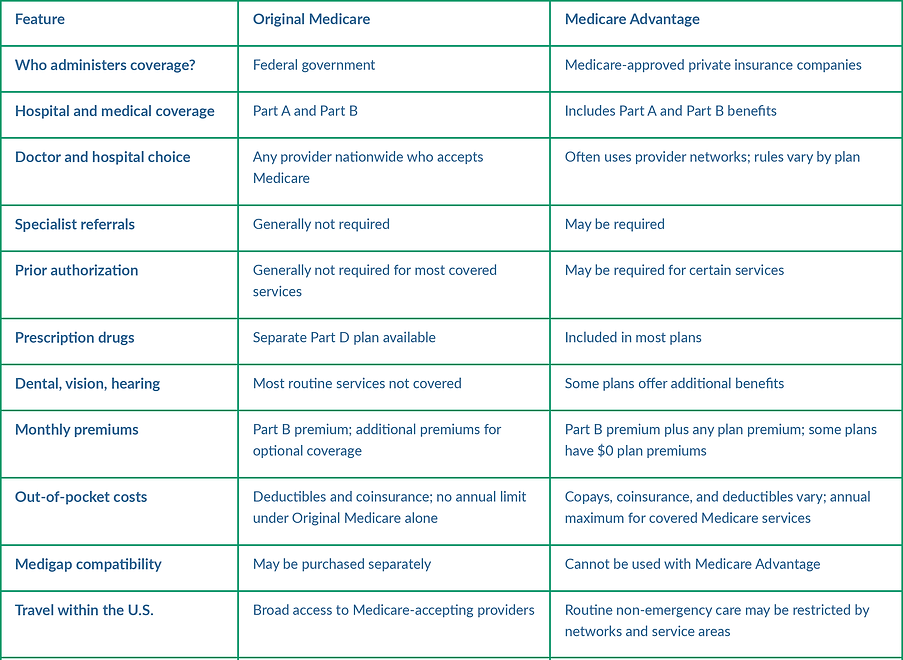
Neither column is automatically better. The right choice depends on which differences matter most to you.
The Biggest Differences to Consider
1. Your Doctors and Hospitals
For many people, this is the most important consideration.
With Original Medicare, you can generally see any healthcare provider nationwide who accepts Medicare. That can be especially appealing if you have established relationships with specialists, spend part of the year in another state, or travel frequently.
Medicare Advantage plans often use networks. An HMO typically has stricter network rules, while a PPO may allow out-of-network care at a higher cost.
Before choosing Medicare Advantage, check whether your preferred doctors, specialists, and hospitals participate in the specific plan you're considering. Don't assume that because a provider accepts Medicare, they also accept every Medicare Advantage plan.
2. Monthly Premiums vs. Total Healthcare Costs
It's easy to focus on the monthly premium, especially when you're living on a fixed retirement income.
But the lowest premium doesn't necessarily mean the lowest overall cost.
With Original Medicare, you'll pay your Part B premium and may also pay for a Part D prescription plan and a Medigap policy. That can mean higher predictable monthly expenses, depending on your choices.
With Medicare Advantage, you may find a plan with a low or $0 additional premium. However, you'll still need to consider copayments, coinsurance, deductibles, and the plan's annual out-of-pocket maximum.
A useful comparison considers both:
-
What you'll pay during a relatively healthy year.
-
What you could pay during a year involving surgery, hospitalization, or ongoing specialist care.
Your budget matters, but so does your ability to handle unexpected expenses.
3. Prescription Drug Coverage
Original Medicare doesn't automatically include outpatient prescription drug coverage. You can generally enroll in a separate Part D plan.
Most Medicare Advantage plans include Part D coverage, although not all do.
Either way, you'll want to review your medications carefully.
Check whether your prescriptions appear on the plan's formulary (its list of covered medications), what you'll pay at your preferred pharmacy, and whether restrictions such as prior authorization or step therapy apply.
A plan that looks affordable until you add prescription costs may not be the best value.
4. Travel and Time Away From Home
If you enjoy visiting family, traveling around the country, or spending part of the year somewhere other than Virginia, pay particular attention to coverage away from home.
Original Medicare generally allows you to receive covered care from any provider nationwide who accepts Medicare.
Medicare Advantage plans must cover emergency and urgently needed services under applicable Medicare rules, but routine non-emergency care may be limited by the plan's network and service area.
Neither option generally provides comprehensive healthcare coverage outside the United States. Some Medigap policies and Medicare Advantage plans offer limited foreign travel emergency benefits.
If travel is part of your retirement plans, it's worth discussing before you enroll.
Original Medicare: Pros and Cons
Advantages
-
Broad nationwide access to doctors and hospitals that accept Medicare.
-
Generally no specialist referrals required.
-
Usually fewer prior authorization requirements.
-
Ability to add a separate Part D prescription plan.
-
Option to purchase Medigap coverage, subject to eligibility and enrollment rules.
Potential Disadvantages
-
No annual out-of-pocket maximum under Original Medicare alone.
-
Prescription drug coverage generally requires a separate plan.
-
Most routine dental, vision, and hearing services aren't covered.
-
Adding Medigap and Part D may increase monthly premiums.
-
Multiple policies may require more coordination.
Original Medicare may appeal to people who prioritize provider flexibility and want the option of supplementing their coverage to manage out-of-pocket costs.
Medicare Advantage: Pros and Cons
Advantages
-
Many plans combine medical and prescription drug coverage.
-
Some plans have low or $0 additional monthly premiums.
-
Annual out-of-pocket maximum for covered Medicare services.
-
Some plans offer dental, vision, hearing, or other extra benefits.
-
A bundled approach may feel simpler to manage.
Potential Disadvantages
-
Provider networks may restrict where you receive routine care.
-
Referrals or prior authorization may be required.
-
Out-of-network care may cost more or may not be covered for non-emergency services.
-
Copayments and other costs can add up during a year with significant healthcare needs.
-
Plan networks, benefits, and costs can change from year to year.
Medicare Advantage may appeal to people who prefer bundled benefits and are comfortable with the network and coverage rules of a particular plan.
Where Does Medicare Supplement Insurance (Medigap) Fit In?
This is where Medicare decisions can become confusing.
Medigap is not the same thing as Medicare Advantage.
Medigap is additional insurance sold by private companies to help pay certain out-of-pocket costs associated with Original Medicare, such as copayments, coinsurance, and deductibles.
It works alongside Original Medicare, rather than replacing it.
You cannot use Medigap to pay Medicare Advantage copayments or deductibles.
There's also an important timing consideration: when you first become eligible for Medigap, you may have enrollment protections that aren't necessarily available later. Depending on your circumstances and state rules, switching from Medicare Advantage back to Original Medicare doesn't guarantee that you'll be able to purchase the Medigap policy you want.
That's one reason to think beyond your first year of coverage.
If you're considering Original Medicare with Medigap versus Medicare Advantage, compare the entire coverage arrangement, not just the monthly premium of one policy. Full Circle's Medicare coverage guidance can help you understand how these options fit together.
Which Medicare Option is Better for You?
There's no universal winner in the Medicare Advantage vs. Original Medicare comparison.
Consider two retirees with different priorities.
One retiree travels frequently and sees several specialists. She wants flexibility to visit providers in different states and prefers fewer network restrictions. Original Medicare, potentially paired with Medigap and Part D, may be worth exploring.
Another retiree primarily receives care close to home. Her preferred doctors participate in a Medicare Advantage plan's network, and she values bundled prescription and additional benefits. That plan may be a good fit if its costs and coverage rules work for her.
Neither person is making a better decision simply because of the type of Medicare coverage they choose.
The better decision is the one based on their individual circumstances.
Before enrolling, ask yourself:
-
Are my preferred doctors, specialists, and hospitals accessible under this option?
-
How much will I pay in monthly premiums and expected out-of-pocket costs?
-
What happens financially if I need extensive medical care?
-
Are my prescriptions covered at an affordable cost?
-
Will the coverage work when I travel or spend time away from home?
-
Do I understand the rules for changing coverage later?
If you can't confidently answer those questions, it's worth getting guidance before making a selection.
Can You Change Your Mind Later?
Yes, but switching coverage isn't always as simple as it sounds.
Medicare's Annual Open Enrollment Period runs from October 15 through December 7. During this period, eligible Medicare beneficiaries can make certain changes between Original Medicare and Medicare Advantage or change prescription drug plans. Changes generally take effect January 1.
People already enrolled in Medicare Advantage also have a separate Medicare Advantage Open Enrollment Period from January 1 through March 31, during which certain changes are permitted.
However, switching from Medicare Advantage to Original Medicare doesn't automatically give you the right to purchase any Medigap policy you want.
Medigap enrollment protections depend on timing, circumstances, and applicable rules. That's why it's important to consider both your current needs and the potential long-term implications of your choice.
Get Personalized Medicare Guidance in Virginia Beach
Choosing Medicare shouldn't feel like a guessing game.
At Full Circle Insurance Solutions, we help people approaching Medicare eligibility and existing Medicare beneficiaries understand their options, compare available coverage, and make informed decisions.
As an independent insurance brokerage based in Virginia Beach, we work with individuals throughout Norfolk, Chesapeake, Hampton Roads, and across Virginia.
We'll take time to understand your healthcare needs, preferred doctors, prescriptions, budget, and lifestyle before helping you evaluate the Medicare options available to you.
You don't have to know which type of Medicare coverage you want before reaching out. That's what we're here to help you figure out.